It started with a small clicking sound.
Nothing dramatic. Nothing alarming. Just a tiny click-click-click that my husband and I noticed one evening while watching Netflix in our living room.
“Did you hear that?” I asked.
He turned down the volume. We both listened.
Click-click-click.
“Probably nothing,” he said, turning the volume back up.
Famous last words.
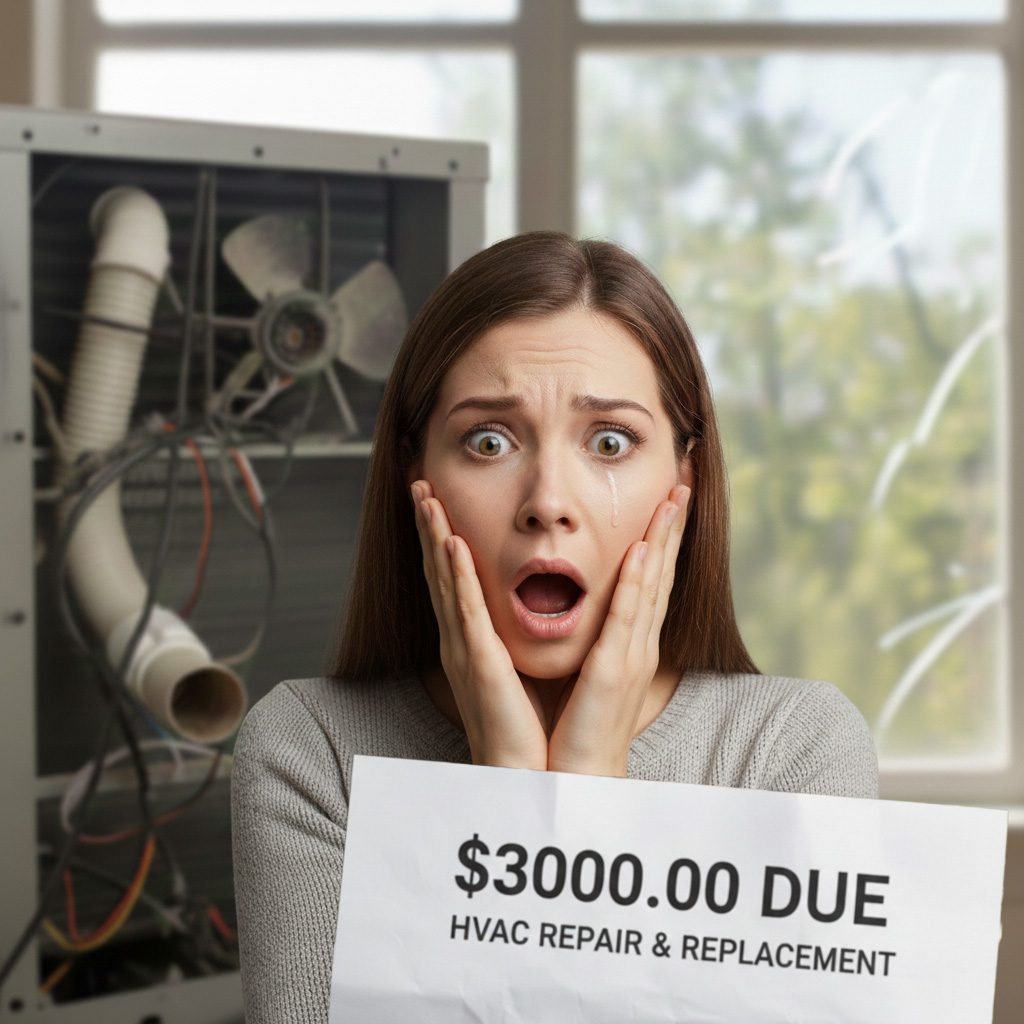
Three months later, we were standing in our kitchen at 2 AM in August, sweating through our pajamas, staring at a dead air conditioning unit while our HVAC technician delivered the news that would make my stomach drop.
“The compressor’s seized. You’re looking at a full system replacement. Around $8,500.”
But here’s the thing that made it worse—the thing that still makes me cringe when I think about it.
He pulled out a small metal part, no bigger than a deck of cards, blackened and twisted from heat damage.
“See this relay switch? This is what was making that clicking noise you probably heard a few months ago. If you’d called me then, it would’ve been a $150 repair. Maybe $300 with a full inspection.”
My stomach turned.
The Sound You Can’t Unhear
That conversation happened four years ago, and I’ve never ignored a strange HVAC noise since.
But here’s what I’ve learned: I’m not alone. Not even close.
According to the Air Conditioning Contractors of America, the average homeowner waits 47 days after noticing an HVAC problem before calling for service. And during those 47 days, a $200 repair can quietly transform into a $2,000 emergency.
Or worse.
Because HVAC systems don’t fail all at once. They fail in stages. And each stage you ignore multiplies both the damage and the cost.
The Five Stages of HVAC Denial
Let me walk you through what actually happens inside your system when you pretend that weird noise doesn’t exist.
Stage One: The Warning Shot
Something small breaks or comes loose. A belt starts to fray. A bearing loses lubrication. A relay switch begins to fail.
Your system compensates. It works harder. And it makes noise—a clicking, rattling, squealing, or humming sound that wasn’t there before.
Cost to fix at this stage: $150 to $500, depending on the part.
Most people’s reaction: “I’ll keep an eye on it.”
Stage Two: The Domino Effect
That small broken part forces other components to work overtime. Your blower motor runs hotter than it should. Your compressor cycles on and off more frequently. Your capacitor strains under the extra load.
The noise might get louder. Or it might change pitch. Or—and this is the dangerous part—it might actually get quieter for a while as the failing component “settles in” to its broken state.
Cost to fix at this stage: $500 to $1,500, because now you’re replacing multiple parts.
Most people’s reaction: “Well, it’s still cooling the house, so…”
Stage Three: The System Civil War
Now your HVAC system is fighting itself. The compressor is working against the blower motor. The thermostat is sending signals that the system can’t properly execute. Energy consumption spikes because nothing is running efficiently anymore.
Your electricity bill jumps. You might notice certain rooms aren’t cooling evenly. The system might start short-cycling—turning on and off every few minutes instead of running in longer, efficient cycles.
Cost to fix at this stage: $1,500 to $3,000, possibly requiring major component replacement.
Most people’s reaction: “It’s just old. This is normal, right?”
Stage Four: The Cascade Failure
A major component gives up entirely. Usually, it’s the compressor, but it could be the blower motor or the condenser fan. And when it fails, it doesn’t fail alone—it takes other parts down with it.
Metal shavings circulate through your refrigerant lines. Electrical surges damage control boards. Heat buildup warps components that were supposed to last another decade.
Cost to fix at this stage: $3,000 to $6,000, possibly requiring partial system replacement.
Most people’s reaction: “How did this happen so fast?”
Stage Five: The Death Sentence
Your HVAC contractor looks at the damage and shakes his head. The cost to repair exceeds 50% of replacement value. The system is 10+ years old. Even if you fix this breakdown, another is inevitable within months.
You need a new system.
Cost: $5,000 to $15,000, depending on your home size and system type.
Most people’s reaction: “We should have called someone when we first heard that noise.”
The Sounds That Cost You Thousands
Not all HVAC noises are created equal. Some are merely annoying. Others are financial time bombs.
Here’s what each sound actually means—and what it’s trying to tell you before it’s too late.
The Click
A single click when your system turns on or off is normal. It’s just the relay engaging or disengaging.
But continuous clicking, or clicking that repeats every few seconds, means your relay is failing, your compressor is struggling to start, or your thermostat has an electrical problem.
Ignore it long enough, and your compressor will burn out from repeated failed start attempts.
Time until major damage: 2 to 4 months.
The Screech
That metal-on-metal shrieking sound is usually a worn-out belt or a motor bearing that’s lost its lubrication.
Your motor is slowly destroying itself. The friction is creating excessive heat. That heat is degrading nearby components.
Stop running your system immediately and call for service.
Time until major damage: 2 to 6 weeks.
The Rattle
Something has come loose inside your system—a panel, a mounting bracket, a fan blade, or debris that’s gotten into your outdoor unit.
If it’s a loose panel, you’re fine. If it’s a loose fan blade, that blade could break free, shred your condenser coils, and turn a $20 problem into a $2,500 disaster.
Time until major damage: Unknown—could be today, could be months.
The Hum (That Gets Louder)
Your system always hums quietly when it runs. But if that hum is getting progressively louder, or if it’s accompanied by vibration, your motor is struggling.
Usually, this means a capacitor is failing. The capacitor gives your motor the electrical “kick” it needs to start. When it weakens, your motor strains, overheats, and eventually burns out.
Replacing a capacitor costs $150 to $300. Replacing a motor costs $500 to $1,200.
Time until major damage: 1 to 3 months.
The Gurgle
Gurgling or bubbling sounds mean you have a refrigerant leak or a condensate drain clog.
If it’s a drain clog, you’ll see water damage within weeks—stained ceilings, warped floors, and potential mold growth.
If it’s a refrigerant leak, your system is slowly losing its ability to cool your home, and whatever’s causing the leak is probably damaging your compressor at the same time.
Time until major damage: 1 to 2 months.
The Math That Should Terrify You
Let’s talk numbers, because that’s where this really hits home.
A comprehensive study by HomeAdvisor found that homeowners who address HVAC issues immediately after noticing symptoms spend an average of $320 per repair.
Homeowners who wait 30 to 60 days spend an average of $1,240 per repair.
Homeowners who wait longer than 90 days spend an average of $2,890 per repair.
That’s a 903% price increase for doing absolutely nothing.
But the repair cost is only part of the story.
While you’re ignoring that strange noise, your HVAC system is running inefficiently. The U.S. Department of Energy estimates that a malfunctioning HVAC system can increase your energy consumption by 20% to 50%.
For the average American household with a $180 monthly summer cooling bill, that’s an extra $36 to $90 per month. Over a three-month summer season, you’re wasting $108 to $270 on electricity—money that could have paid for that initial repair.
And we haven’t even talked about the health costs.
A struggling HVAC system doesn’t maintain proper humidity levels. It doesn’t filter air effectively. It creates the perfect environment for mold growth, dust mite proliferation, and allergen buildup.
According to the American College of Allergy, Asthma, and Immunology, poor indoor air quality contributes to $15 billion in annual healthcare costs in the United States.
Your $150 clicking noise isn’t just costing you money. It’s potentially affecting your family’s respiratory health, sleep quality, and overall well-being.
What Actually Happens During a Service Call
I know what you’re thinking: “But what if it’s nothing? What if I pay $100 for a service call and the technician tells me it’s fine?”
Let me tell you what that $100 service call actually buys you.
A qualified HVAC technician will inspect your entire system—indoor and outdoor units. They’ll check refrigerant levels, test electrical connections, measure airflow, inspect your condensate drain, examine your ductwork, and listen to your system run through multiple cycles.
They’ll catch problems you didn’t even know existed.
During the service call for my clicking noise (the one I didn’t make until it was too late), the technician found three other issues: a partially clogged air filter, a condensate drain that was 80% blocked, and an electrical connection that was starting to corrode.
Any one of those problems could have caused a breakdown within six months.
And here’s the thing most people don’t realize: most HVAC companies offer free estimates on repairs. You pay for the diagnostic visit, they tell you what’s wrong, and then you get a written quote before any work begins.
You’re not committing to a $1,000 repair by making a $100 service call. You’re buying information. You’re buying peace of mind. And you’re potentially saving yourself thousands of dollars.
The Questions You Should Ask (But Probably Won’t)
When you finally break down and call an HVAC company, here’s what you need to ask—questions that separate honest technicians from the ones who see your ignored warning signs as a profit opportunity.
“What caused this problem, and could it have been prevented?”
An honest answer gives you information. A vague answer suggests they’re not really sure what they’re looking at—or they’re not willing to tell you that this was preventable.
“What other components might be affected by this failure?”
This question forces them to think systematically. If your compressor failed, what about your condenser? Your refrigerant lines? Your control board? A good technician will check everything connected to the failed part.
“If I repair this, what’s the realistic lifespan of my system?”
If you’re putting $2,500 into a 15-year-old system, you need to know whether you’re buying six months or six years. Sometimes repair is smart. Sometimes replacement is smarter.
“What would you do if this was your house?”
This is my favorite question, because it puts the technician in your shoes. Most of them own homes. Most of them have HVAC systems. And most of them—if they’re honest—will tell you exactly what they’d do with their own money.
The Noise That Saved My Neighbor $7,000
My neighbor Tom heard a rattling noise from his outdoor AC unit last June.
He called me immediately. “You’re the person who ignored the clicking noise and paid $8,500 for a new system, right?”
“That’s me,” I said. “Call someone today.”
He did.
The technician found a small branch that had fallen into the unit and was rattling against the fan blades. The branch had been there less than a week. Another few days, and it would have broken loose a blade, which would have destroyed the condenser coils, which would have required a complete outdoor unit replacement.
Total cost: $89 for the service call.
Total cost if he’d waited another week: $3,500 to $7,000.
Tom bought me a bottle of wine and told everyone on our street the story. Now, anytime anyone hears a weird HVAC noise, they call for service within 48 hours.
Our neighborhood Facebook group has probably saved $50,000 in avoided HVAC emergencies over the past three years.
The Decision You’re Actually Making
Here’s what it comes down to.
When you hear that strange noise and decide to ignore it, you’re not deciding whether or not to fix your HVAC system.
You’re deciding whether to fix it now, for hundreds of dollars, or later, for thousands of dollars.
You’re deciding whether to fix it at a time of your choosing, during normal business hours, with multiple contractors to choose from—or at 2 AM on the hottest night of the year, with whoever can come out on emergency rates.
You’re deciding whether to have control over this situation, or to let the situation control you.
Because that noise isn’t going to stop on its own. That problem isn’t going to fix itself. And every day you wait, the damage multiplies.
What I Do Now (And What You Should Do Tomorrow)
I schedule HVAC maintenance twice a year now—spring and fall. It costs $200 per year for both visits.
During those visits, technicians catch small problems before they become noise-making problems. They replace worn belts. They lubricate bearings. They clean components that are accumulating debris. They tighten connections that have vibrated loose.
In four years since my $8,500 lesson, I’ve spent $800 on preventive maintenance.
I’ve spent $0 on emergency repairs.
And the two times I’ve heard unusual noises between maintenance visits, I’ve called immediately. Both times, it was something small—a loose panel in one case, a leaf stuck in the outdoor unit in the other case.
Both times, it cost me nothing beyond the service call.
Both times, I slept better that night.
The Sound You Need to Hear
That clicking, rattling, screeching, or humming noise coming from your HVAC system isn’t background noise.
It’s a warning.
It’s your system telling you, in the only language it knows, that something is wrong—something that’s going to get worse, something that’s going to get expensive, something that you can still do something about if you act now.
So here’s my challenge to you.
Right now, today, before you finish reading this article, I want you to go stand next to your HVAC system—both the indoor and outdoor units—and just listen.
Really listen.
Is everything quiet and normal? Great. You’re good.
Or do you hear something that wasn’t there last month? Something that makes you think, “Hmm, that’s a little weird”?
If you hear something weird, you know what to do.
Make the call. Schedule the service visit. Spend the $100 to $200 for a diagnostic.
Because in three months, that weird noise might be gone.
But it won’t be gone because the problem fixed itself.
It’ll be gone because the component that was making the noise has completely failed, taking three other components down with it, and now instead of hearing a strange noise, you’re hearing the deafening silence of an HVAC system that’s just given up entirely.
And you’re writing a check with more zeros than you ever wanted to see.
Don’t be me, standing in my kitchen at 2 AM, listening to my HVAC technician explain how I turned a $150 problem into an $8,500 disaster.
Be Tom, who made a phone call and saved $7,000.
Here’s what to do next :
📞 Call Us Now: phoneformatvar
Request a free quote
or Schedule a service
The choice is yours.
But you’d better make it before that strange noise stops.